
I am not a Writer. I am a tech exec, a dad, a software engineer, and a human with ideas I want to share. AI has been a huge unlock for me in doing this. Pre-AI, I struggled to publish anything. While I had plenty of ideas that were baked enough to share, the actual process of translating them from my head into written text was very slow. This struggle is evidenced by this early post on this Substack, where all I managed to do was write about how I wasn’t writing anything.
My process for writing articles is straightforward: I start with a topic I want to discuss. I then build a fairly dense outline, complete with examples and a point-by-point breakdown of what I’m trying to say. I know what I want to say. I use AI to help augment my research along the way. When it’s time to write, I pass the outline to a personal GPT, which has been trained on my past, pre-AI content to capture something of my voice. It then generates the text. There is an iteration process there where we work together to refine it. I also ask other LLMs to challenge the work to pressure test both the ideas and the writing.
Does this diminish the content of this blog? I don’t think so.
My brother texted me the other day, saying, “Some of your blog sounds like it was written by AI.” I responded, “Of course it does, because it is!” I understand his reaction, because I do it too: when I consume something and begin to suspect it was AI-written, my hackles go up, and I immediately become more skeptical of its quality. I believe we need to move past that reaction. This is related to an earlier piece where I built a mental model for how to grapple with the use of AI in media content.
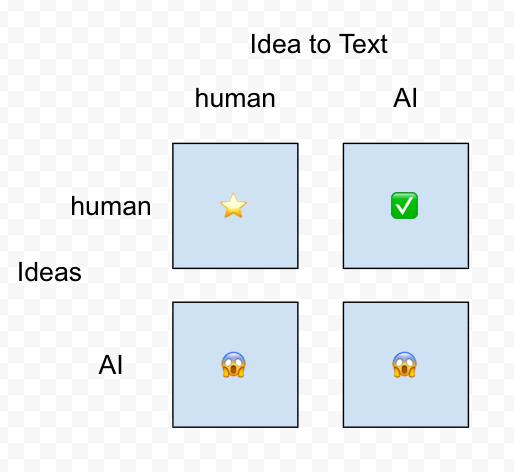
Similar to that article, I think we can build a truth table. One axis is whether the ideas being described are AI-Generated or Human-Generated. For where AI is now, none of the ideas it generates are interesting to read. It truly feels like slop. Now, of course, a lot of human-generated ideas are not that interesting either. But for the sake of our mental model, we’re going to assume a decent hit rate on humans sharing interesting thoughts and wrestling with hard problems.
The second axis is how the idea gets presented. As a software engineer, I think of the presentation as merely a “display layer.” In engineering, we’d consider whether functionality was being exposed via an API, a GUI, a mobile app, a chatbot, etc. These are different display layers. Genuinely useful products can become useless because of a bad interface. However, a fundamentally unuseful product cannot be saved by a nice display layer.
Given the time I am willing to put in, I cannot create a high enough quality display layer for my work. Yes, I could probably spend years learning the craft, but that opportunity cost is too high. AI lowers the barrier, enabling me to produce readable content quickly. The other axis on our truth table, therefore, is whether the “display layer,” or the text itself, is generated. We should be totally okay with the quadrant where the idea is human-generated, but the text is AI-written. That certainly doesn’t diminish the fully human-generated and written content. We can safely ignore all AI-generated ideas (at least for now).
My commitment in writing this blog is that I will never publish AI-generated ideas. I will not say, “Hey Claude, write an article in my voice about unit tests.” I will continue to take a human-generated thesis or outline and ask Claude to turn it into text. We are going to live in the top-right corner of that truth table.
I am not a Writer. My differentiation is not in the craft or style of my prose; the prose is simply a means of providing a display layer for the conversations and theses I want to share. With AI, I can take an idea that I’ve already baked and produce a full article in 15 minutes at a higher level of polish than if I put in hours. For people who are Writers, I understand why relying on AI to write the final text generally would not make sense; the prose itself is part of their differentiator. Naturally, the barrier to entry for people writing using AI like I do makes that field more competitive. I can imagine that is frustrating because it was already a brutal field.
My hope is that as consumers we can learn to identify the AI text generation that is helping share interesting ideas from that which does not, instead of immediately disregarding it. I look forward to continuing this experiment here in sharing ideas and takes that I think are genuinely interesting and challenging.